

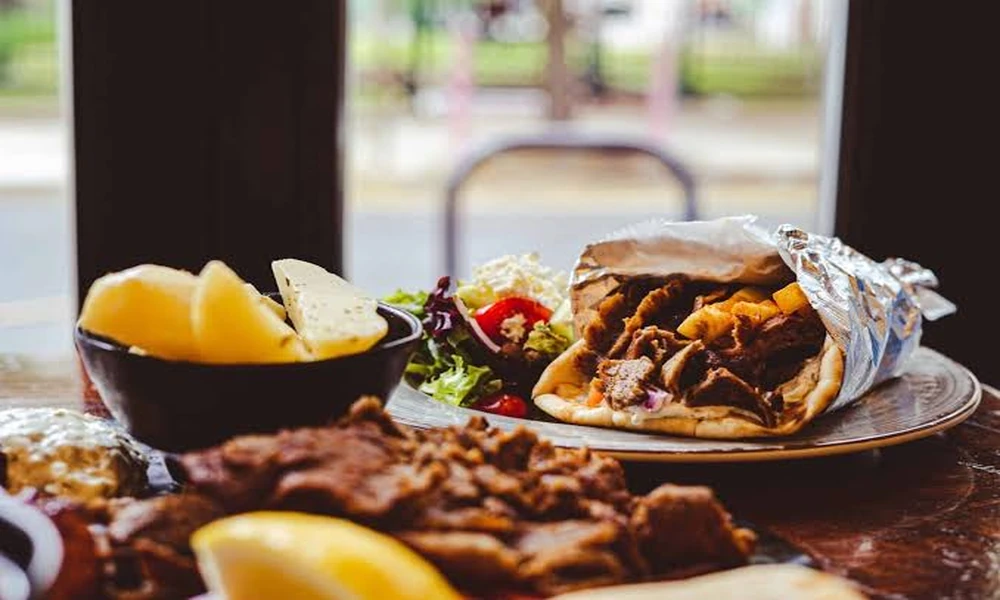
The Pita Wrap Confusion That Won’t Quit
A decade ago, most diners outside major cities had never heard the word gyro spoken correctly, let alone ordered one with any confidence. Food trucks and late-night takeout counters introduced the dish to a wider audience, but they also introduced a flattened version of it, one that treated the gyro as interchangeable with any other wrapped sandwich. That shortcut stuck around longer than it should have. Many people still picture a gyro as a generic pita stuffed with whatever meat happens to be on the rotisserie that day, seasoned loosely and assembled without much thought.
That assumption misses what separates a proper gyro from the fast-casual imitation. The seasoning blend, the way the meat is layered and cooked on a vertical spit, the thickness of the pita, and the balance of sauce all matter more than casual eaters tend to realize. A gyro made with pressed, over-processed meat and bottled sauce is not a lesser version of the real thing; it is a different food entirely wearing the same name. This confusion has made it harder for people to know what they are actually ordering, and harder for restaurants doing it properly to stand out in a crowded field of lookalikes.
Reading a Menu Like Someone Who Knows the Difference
Once you understand what distinguishes a well-made gyro, the ordering process changes. Restaurants that take the dish seriously tend to describe their preparation in specific terms rather than vague ones, and that specificity is worth paying attention to. Spitz built its reputation on this kind of transparency, offering Mediterranean gyros that reflect traditional technique rather than a shortcut version aimed at speed over flavor. The seasoning is layered into the meat itself, not added afterward to mask a bland base, and the spit-roasting method gives the exterior a texture that a flat-top griddle simply cannot replicate.
The sauce matters just as much as the meat, though it rarely gets the same attention. A tzatziki made with strained yogurt, fresh garlic, and properly drained cucumber behaves differently on the palate than a thinned-out, pre-made substitute. It holds its tang without turning watery, and it complements the meat instead of diluting it. Pita quality plays a similar role; a pita that’s been warmed properly and has enough structure to hold its fillings without tearing changes the entire eating experience. None of this is complicated information, but it rarely gets explained to customers who are simply trying to decide what to order for lunch.
Ordering With Intention Instead of Habit
Applying this knowledge doesn’t require turning lunch into a research project. It mostly means paying attention to a few details that tend to separate thoughtful preparation from rushed assembly. Ask how the meat is cooked, whether the sauce is made in-house, and whether the pita is toasted or simply microwaved. These questions take seconds to ask and tend to reveal a lot about how seriously a kitchen treats the dish.
It also helps to notice texture and aroma before the first bite. A well-prepared gyro has a slightly charred edge on the meat from the vertical rotisserie, a pita with some structure and warmth, and a sauce that smells like fresh herbs rather than preservatives. These are not subtle differences once you know to look for them. Ordering becomes less about brand loyalty and more about recognizing craftsmanship, which tends to make the meal more satisfying regardless of where you’re eating.
Over time, this kind of attention changes how people approach the dish altogether. They stop treating gyros as a generic fast-food category and start recognizing it as something with real technique behind it, shaped by regional tradition and careful execution. That shift in perspective doesn’t require expertise or a culinary background. It just requires noticing what’s actually on the plate, and letting that observation guide the next decision at the counter.